
Social and Environmental Concerns
Let The Light Shine
In 2011 a member of Media Meeting, who was well versed in solar power and had lived “off the grid” in California, raised a leading to add solar panels to the gym roof on our property.
Our meeting discerned to move forward with the solar panel project. In doing so, we made a commitment to lowering our property’s carbon footprint, provide educational opportunities for our resident Friends school – Media Providence Friends School, and be a witness to the wider community for sustainable energy usage. Friends’ testimonies include Stewardship of the Earth and this guided our discernment.
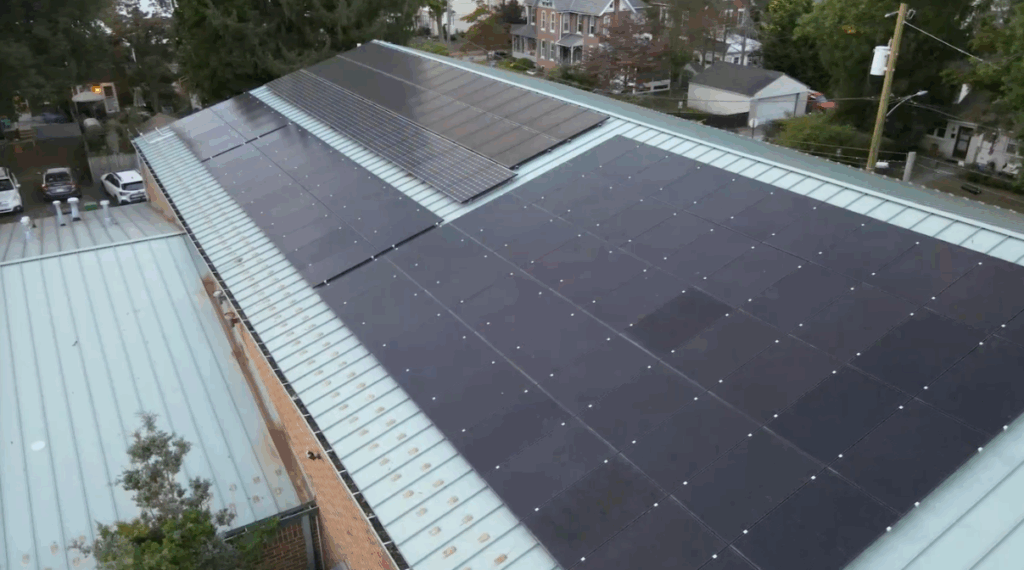
The initial project included the installation of 34 panels and required reinforcement of the gym ceiling. We invested in panels that had online access to show their electrical production. This was to create educational opportunities for the school students.
We financed the project with a grant from PYM (Philadelphia Yearly Meeting), and fund raising that included our meeting and school community members.
In 2018 we used our solar savings and another grant from PYM, to complete a small expansion. This project added 17 panels to the roof, bringing our total panel count to 51.
Media Meeting continued to seek ways to reduce our campus carbon footprint. We worked with the school to do a PECO energy audit. This led to a campus wide conversion to LED lights. This had a significant impact on electric usage.
When the Meeting learned that the US Government had introduced legislation to provide federal credit for nonprofit organizations to install solar panels, we decided to commit to a major expansion project, adding 89 panels. We contracted with a local company, Solar States, to manage the installation. Our third solar project was completed in the summer of 2024 and was funded by a meeting. We now have a total of 140 solar panels! We are producing enough energy to cover the electrical usage of the gym and middle school building, as well as offsetting the electrical usage in the main meetinghouse building!
Media Meeting continues to seek ways to reduce fossil fuel energy use on our property and move towards our goal of being carbon neutral. We appreciate our partnership with Media Providence Friends School in this endeavor. Our Joint Meeting/School Green Committee makes recommendations for how to utilize our Alternative Energy Funds. We welcome meeting and school initiated ideas and can provide funding assistance for projects that move us toward our goal. For more information contact the Joint Green Committee by emailing mediameeting1865@gmail.com. SHINE ON
Herb Project
A Quaker Grow Site and A Collaboration Between Media Friends Meeting and Media-Providence Friends School (MPFS), and Singularity Botanicals
MEANINGFUL LEARNING IN MEDICINAL PLANTS supporting our community with an eye for a changing climate
Since the Spring of 2022, Media Meeting has been an official grow site for the African Diaspora Earth Care Coalition and Singularity Botanicals in Chester, Pennsylvania. Media Meeting has coordinated with the middle school students and teachers of Media Providence Friends School (MPFS) to help with this project, and engage in hands on learning.
According to their website (singularitybotanicals.net), “Singularity Botanicals produces medicinal herbs and offers multifaceted educational programs which support their cultivation and use.” Singularity Botanical, founded by Pamela Boyce Simms, “fosters plant medicine selfcare sovereignty to ensure that populations which are the most climate change-vulnerable have access to, and can produce their own natural medicine.”
We have 3, 8’ x 4’, garden beds that surround the MPFS middle school building, brightening the playground with greenery and small, flowering buds. Students, aided by members of our Meeting, dig and fill the beds and plant the various herbs. In our current (fourth year) we are growing: Holy Basil, St. John’s Wort (full bed), Skullcap, and Calendula (full bed). There are identifying signs for all 4 herbs, so go take a look!
The eighth graders shared a strong sense of purpose and pride towards improving social and environmental injustices within their community. One student noted that tending to the herbs was ‘plant’ therapy.
If anyone wants to be involved in any aspect of this project, please contact:
Wayne Peischl at rainwayne@gmail.com or Greta Hudak at gretahudak@gmail.com !
2025 Herbs - 4th Growing Season!
Ocimum tenuiflorum
Life Cycle – Tulsi is an annual or short-lived tropical perennial that will often self-seed and produce successive generations of plants when allowed to go to seed and given ample space and good conditions to grow.
Plant Description
Tulsi is a fragrant and delicious member of the Lamiaceae family and is native to India, growing prolifically throughout Asia. Tulsi is an erect, bushy plant that grows about two feet tall. Depending on the variety, the leaves range from green to purple and are lance shaped. The flowers grow on spikes and are a deep purple. One of the most delightful aspects of tulsi is its wonderful, heady scent.
Medicinal Uses
Tulsi is an adaptogen herb that improves immunity and invigorates the body. It relieves stress and tonifies body systems. It lowers blood pressure. Holy Basil significantly lowers blood sugar, without side effects, and can be an anti-inflammatory that protects the hearts.
Calendula officinalis
Life Cycle – Calendula is an annual at temperate climates.
Plant Description
It is often referred to as pot marigold, is a member of the Asteraceae family, and is native to southern Europe. The aerial part of the plant is upright and bushy, growing two to three feet tall with bright green leaves. The flowers can range from small yellow blossoms to big sunbursts of flowers. The flowers are sticky and fragrant, containing medicinal resins, and attract many pollinators.
Medicinal Uses
Calendula blossoms are used both internally and externally. Externally, the flowers are used to heal burns, cuts, and skin abrasions. Not only does calendula promote cellular healing, it is also antiseptic and antimicrobial and helps fight infection. Internally, it is a strong lymphatic, excellent for tonifying the lymphatic system and flushing toxins. It can be taken internally in tea or tincture form.
Hypericum perforatum
Life Cycle – St. John’s Wort is an herbaceous perennial that is hardy to USDA zones 3 to 9.
Plant Description
St. John’s wort is native to Europe, Asia, and northern Africa, and can be considered a noxious weed to some. It is an erect perennial that grows two to three feet tall and has clusters of bright yellow flowers, each composed of five petals in the shape of a sunburst or star. When blossoming, flowers contain bright red oil that can be seen when the flowers are squeezed. The presence of the red oil is an indication that the tops are ready to harvest.
Medicinal Uses
It is use to make medicinal oils and liniments, and topically, nothing compares to its ability to sooth irritated and inflamed nerve endings and damaged tissue. It helps to alleviate mild depression, especially depression caused by the change of seasons and lack of sunshine.
Scutellaria lateriflora
Life Cycle – Skullcap is an herbaceous perennial hardy to USDA zones 4 to 10.
Plant Description
Skullcap is from the Lamiaceae family and is a mint native to North America. The name skullcap may refer to the fact that some have thought that the flowers resemble skulls with little caps. Others say that the name skullcap was given in reference to the herb’s ability to calm a headache.
Medicinal Uses
Skullcap is premier nervine. It is used in tincture and tea form and has a wonderful way of calming and centering the nervous system. Skullcap acts as a mild yet effective sedative and helps relieve nervous tension and anxiety.